Node Zero, Kentucky: Design Preview of the Future Site — CryptEco Innovations
An honest report from the run-up to commissioning the first integrated Auric™ node on a working farm in Northern Kentucky.
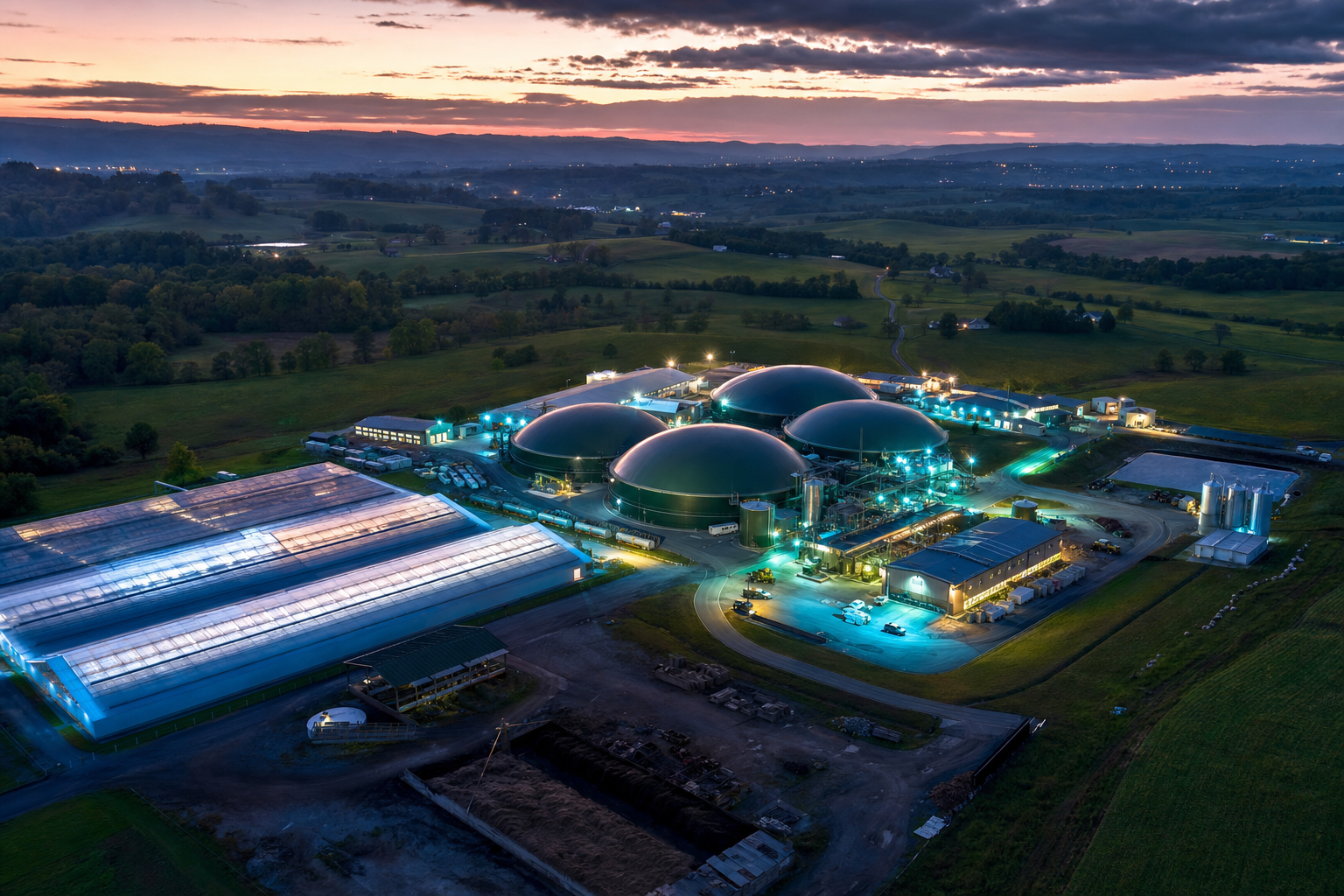
It is one thing to write a platform spec sheet. It is another thing to plan its placement on a working farm in Northern Kentucky.
This is a design preview for the first integrated Auric deployment — Node Zero — written before commissioning so that nothing is sanitized in retrospect. We will write a follow-up after first biogas, after first kWh exported, and after first greenhouse harvest. This post is about the parts that surprised us in the run-up.
Why Northern Kentucky
The future site sits in northeastern Kentucky along the Ohio River. The site itself is operated by Leovara Estates LLC, CryptEco’s sister entity, on a property that combines livestock acreage and cropland. Three things made it the right Node Zero site.
- Feedstock density. The combined on-property and regional partner manure throughput is well-matched to the Auric C5-A-50 Pulse™ module’s 5–8 t/d intake band.
- Grid intertie. The local utility infrastructure can accept a 50 kWe export under standard interconnection without major upgrades.
- Aligned operator. Leovara Estates is family-controlled and structurally aligned with CryptEco. Decisions move at the speed of an engineering org, not a procurement committee.
That third point matters more than it sounds. Most distributed bioenergy projects die in coordination overhead between landowner, operator, equipment vendor, and grant counsel. Node Zero collapses three of those roles into one corporate family.
Sitework realities
Pulse, ExerGen™, and the EGrow Labs greenhouse all have non-trivial sitework requirements. The digester needs a graded, well-drained pad with secondary containment. The CHP needs a concrete pad, exhaust routing, and a clean line back to the grid intertie. The greenhouse needs water, glycol-loop hydronic plumbing for ExerGen heat recovery, a CO₂ delivery line, and electrical service.
The unanticipated work was the interconnect between them. The hydronic loop from ExerGen jacket water to greenhouse hydronic header is straightforward on paper. In practice it required a glycol reservoir, isolation valves at three points so each subsystem can be serviced without draining the others, and routing decisions that we revised twice as we walked the site.
We documented this in Auric DT™ — the digital twin — as we went. The result is a sitework model that subsequent nodes will start from rather than re-derive.
What we expected to be hard, and was
- Feedstock contracting. Tipping-fee contracts that are durable across years require partners who are willing to commit to a multi-year hauling relationship. That conversation takes longer than a procurement cycle.
- Air permitting. A bioenergy CHP has emissions that need permitting at the state level. The substance of the permit is not difficult — modern engines are clean — but the process is real.
- Grid interconnection. Even a small 50 kWe export takes months of utility-side review. This is not a Kentucky issue; it is a U.S. issue.
What we expected to be hard, and was easier than expected
- Community. We expected more skepticism from neighbors than we got. The two questions we were asked most often were “does it smell?” (no — covered digester, biogas combusted, not flared) and “does it create more truck traffic?” (modestly, from feedstock deliveries, and well within ag-zone norms). After the second visit, the conversation moved from “should this happen” to “when will the greens be available.”
- Operator hiring. Kentucky has a deep pool of people who understand both ag operations and industrial maintenance. We did not have to import operations talent.
What surprised us
The greenhouse drove more of the early platform decisions than we expected. EGrow Labs’ growing program — leafy greens and herbs in an aquaponic recirculating loop, with fish in the system — has tighter CO₂ scheduling requirements than the bioenergy side does. Plant photosynthesis wants CO₂ on a daylight schedule; ExerGen wants to run on a grid-economics schedule. Aurixen OS™ now treats CO₂ scheduling as a first-class optimization variable rather than a downstream byproduct, and that decision came from the greenhouse team, not the bioenergy team.
That kind of cross-subsystem feedback is exactly what the platform thesis predicts. It is gratifying to see it show up in a real specification change before commissioning rather than in a postmortem after.
What we’ll write next
The next field report will be from first biogas — when Pulse has been running long enough to start producing measurable methane. The one after that will be from first export — when ExerGen synchronizes to the grid and the first kWh leaves the property. Both will be written candidly, including anything that doesn’t go to plan.
If you want field reports as we publish them, the subscription form on the News & Insights page sends one email per substantive update. No marketing volume.

