Inside Auric Pulse™: How Anaerobic Digestion Becomes a Revenue Stack — CryptEco Innovations
How a single Auric Pulse module produces four stacked, decorrelated revenue lines — and why we treat them as a stack, not a portfolio.

Most pitches for distributed anaerobic digestion start with the engineering. We’re going to start with the money — because the only reason a digester gets built is that the economics close.
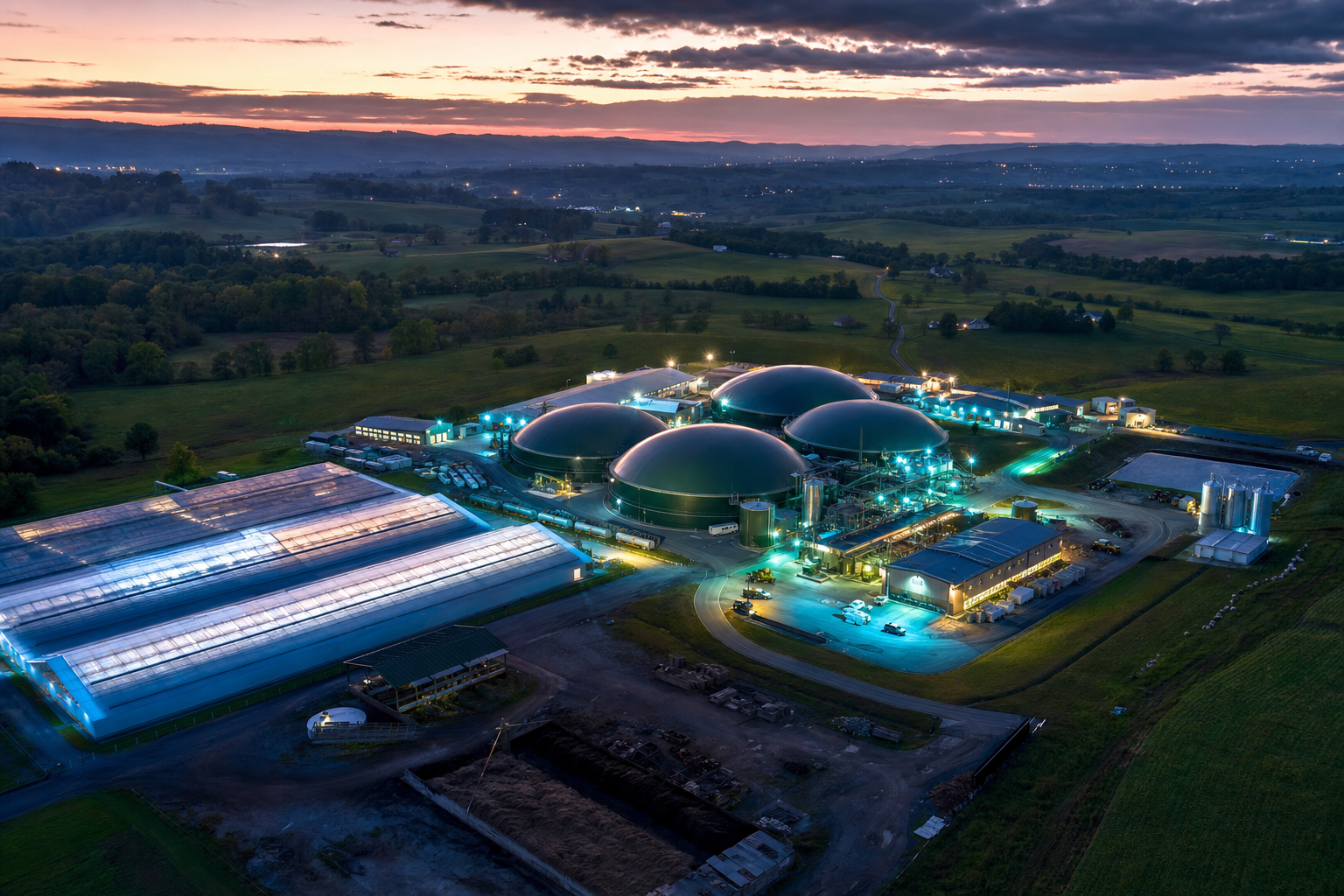
Auric Pulse is CryptEco’s anaerobic digester module. On its own it converts organic waste into biogas, which is interesting but not, by itself, a business. The business is what happens when you stack the four revenue lines that a single Pulse™ module can produce, against a feedstock supply that someone is already paying to get rid of.
Stream 1 — Tipping fees
The first revenue line shows up before the digester has produced a single liter of biogas. Organic waste is, in most regions, a problem someone is paying to dispose of. Dairy manure has handling costs. Food-processing residue has trucking and landfill costs. Distillery spent grain has variable but real handling costs. The Pulse intake at Node Zero is a destination for those streams, and the host pays a per-ton tipping fee to deliver them.
This stream alone is worth understanding because it’s the only revenue stream in the platform that is uncorrelated with energy markets. Even in a year when natural gas prices collapse and electricity is in oversupply, the regional dairy still needs somewhere to put manure.
Stream 2 — Electricity
Biogas from Pulse feeds Auric ExerGen™ — the physical CHP system at the node. ExerGen™ produces electricity at roughly 33–36% electrical efficiency (LHV basis) at design point, which on the Auric™ C5-A-50 reference configuration is a 50 kWe nameplate continuous output.
That electricity has three possible destinations. It can be exported grid-parallel under an interconnection agreement and sold under whatever PURPA or state-level mechanism is available. It can offset on-site farm load — which, at retail rates rather than wholesale, is usually the better dollar per kWh outcome. Or it can be modulated down so that biogas is preferentially routed into the RNG upgrading path.
Aurixen OS™ — the platform’s operating system — chooses between these destinations in real time based on grid price, on-site load forecast, and RNG offtake economics.
Stream 3 — RNG and RIN credits
This is the line that has changed the economics of distributed digestion in the last decade. When biogas is upgraded to pipeline-quality renewable natural gas (RNG) and injected into the gas pipeline, the molecules earn renewable identification numbers (RINs) under the federal Renewable Fuel Standard. Depending on offtake routing — particularly California-bound transportation use — the same gas can also earn California Low Carbon Fuel Standard (LCFS) credits.
For a Pulse-scale project the RNG path is not the only path. It requires biogas upgrading equipment, a pipeline interconnect, and a competent offtake counterparty. But where it is available, it materially shifts the project IRR upward — sometimes from “marginal” to “decisively investable” — because the RIN program prices in the avoided methane emissions, which is exactly what Pulse delivers.
At Node Zero we are modeling both an electricity-priority configuration and an RNG-priority configuration, and Aurixen OS will be able to flex between them as offtake matures.
Stream 4 — Carbon offsets
Methane avoidance is one of the cleanest stories in voluntary carbon markets. Manure that would otherwise emit methane to the atmosphere as it decomposes in a lagoon — and methane is roughly 28x more potent than CO₂ on a 100-year horizon — is instead captured and combusted in ExerGen. That avoided emission is registry-quality, additionality-friendly, and measurable.
The exact dollar value of a carbon offset is the most volatile of the four streams. Voluntary carbon prices have been cyclical, and compliance prices vary by jurisdiction. The reason we treat it as a real fourth stream rather than a footnote is that the underlying methane reduction is a real, measured, third-party-verifiable cubic meter of gas that didn’t enter the atmosphere.
The honest framing
No single one of these four streams is bankable on its own. Each of them is correlated with a different policy or market — federal RFS, state LCFS programs, voluntary carbon registries, regional waste markets, regional electricity markets. The reason CryptEco treats them as a stack rather than a portfolio is that the stack is more durable than any of its parts.
When carbon prices fall, RIN prices have historically held. When electricity prices fall, tipping fees don’t move. When RIN prices fall, the underlying displaced fossil energy still has retail value. The Pulse module is engineered to make all four work simultaneously — and Aurixen OS is the software layer that decides, hour by hour, which mix the node is optimizing for.
This is what we mean when we say the platform is the product. Pulse, on its own, is an interesting piece of equipment. Pulse plus ExerGen plus Aurixen OS plus a thoughtful revenue stack is a project you can finance.
We’ll cover the operating system layer in the next post.